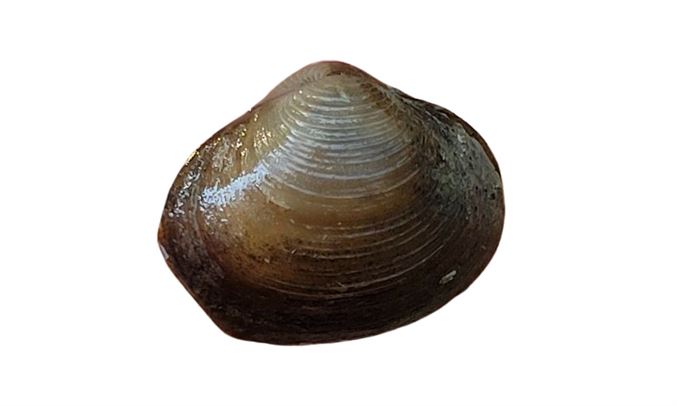
The shells of this species exhibit a range of characteristics, with a size that typically falls within the medium to large category and a moderate inflation. The shell wall varies from moderately thin to fairly thick, and the beaks tend to incline towards the anterior end, ranging from low to prominent. Irregular striations are present, with some specimens heavily striated throughout, while others may only show pronounced striations on the beaks that fade towards the outer part of the shell. The shells may have a dull periostracum, although the lake form occasionally develops a glossy appearance. The dorsal margin is of medium length, curving roundly and fairly evenly, while the ventral margin is longer and more openly curved. The anterior end is typically rounded, smoothly joining the dorsal margin without an angle and the ventral margin with or without a rounded angle. The posterior end usually slopes to join the margins, with or without an angle. The hinge is characterized by its length, considerable and uneven curvature, and a slight dip at the proximal end of anterior laterals. The inner anterior laterals project noticeably into the interior of the shell. The hinge-plate is fairly long and narrow, slightly wider at the posterior end. The laterals are relatively short, and the proximal ends of certain laterals may appear to dip under the hinge-plate. The cusps of the right valve are low and blunt, while those of the left valve are somewhat higher and blunt.The young of all forms share a similar rectangular outline, with somewhat flattened dorsal and ventral margins, and ends that slope more distinctly, forming angles as they join the dorsal margin.